
Research Experience
CFD-Based Evaluation of Shelf Configurations for Improved Temperature Uniformity in a Natural-Convection Domestic Refrigerator Compartment
Md Ridwanul Hasan Rafi, Afnan Hasan*Anik Hasan,Raihan Ahmed Redoy & Farhan Parvez
Sept 2025- Feb 2026
Abstract
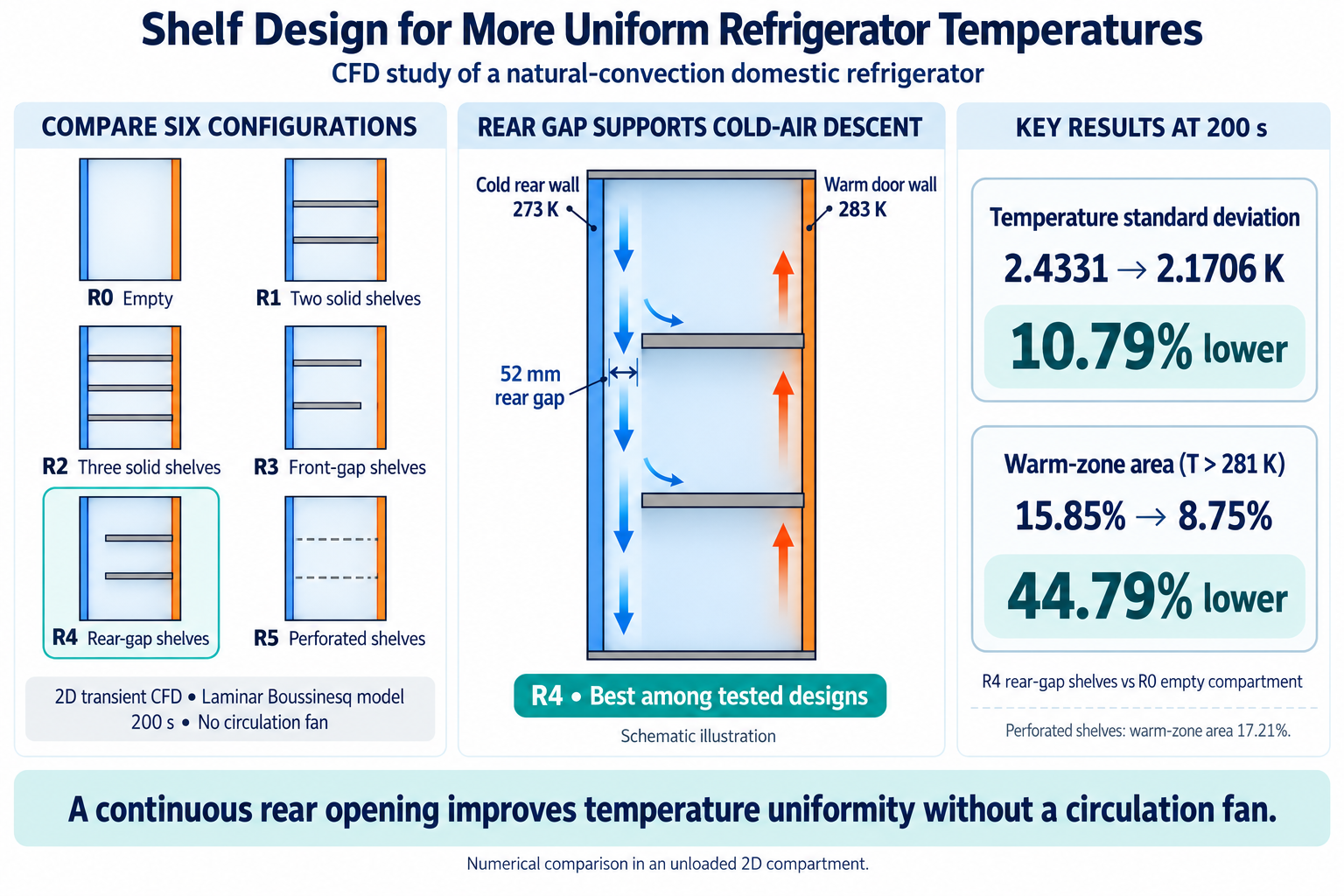
A typical natural-convection refrigerator experiences vertical thermal stratification, while the geometry of the shelf obstructs or directs buoyancy-driven circulation. To assess this hypothesis, six two-dimensional shelf configurations were evaluated numerically in a domestic refrigerator compartment: empty baseline; two solid shelves; three solid shelves; front-gap shelves; rear-gap shelves and perforated shelves. Pressure-based transient simulations were performed with laminar Boussinesq air, a 273K cold back wall, a 283 K warm door wall, adiabatic horizontal boundaries (e.g. x-compression and z-no-slip), time step of 0.1s and total simulated time of 200 s. The predicted average Nusselt number was 8.8862 compared with the reference value of 8.863, corresponding to a 0.26% error. Temperature uniformity was evaluated with the standard deviation of temperature and area fraction larger than 281 K. The configuration of rear-gap demonstrated 2.1706 K, which corresponds to a reduction of 10.79% from empty compartment regarding temperature standard deviation. It also lowered the warm-zone fraction from 15.85 to 8.75 %, a total decrease of 44.79 %. The second lowest warm-zone fraction was found for the front-gap case and perforated shelves increased the warm-zone fraction to 17.21%. According to results obtained, a continuous opening positioned close to the cold-wall boundary layer for cool wall systems performs better than small openings dispersed through shelves under the current investigation.
Objective
The main objective of this paper is to investigate how shelf design influences air circulation and temperature distribution inside a domestic refrigerator operating without a fan. Cold air naturally moves downward, while warm air rises, but shelves can obstruct or redirect this movement, creating uneven temperatures. Using CFD simulations, the study compares six shelf configurations an empty compartment, two solid shelves, three solid shelves, front-gap shelves, rear-gap shelves, and perforated shelves. It aims to identify which arrangement allows better airflow between shelf levels and reduces warm regions, producing a more uniform temperature throughout the compartment.
Graphical Representation
Key Points
- Conducted 2D CFD analysis of six refrigerator shelf configurations to study natural-convection airflow and thermal stratification.
- Assessed temperature uniformity and warm-zone reduction, with the rear-gap shelf achieving a 10.79% warm-zone fraction and improved cooling performance.
- Found that continuous cold-wall openings improved performance by reducing warm-zone fraction from 15.85% to 8.75%.